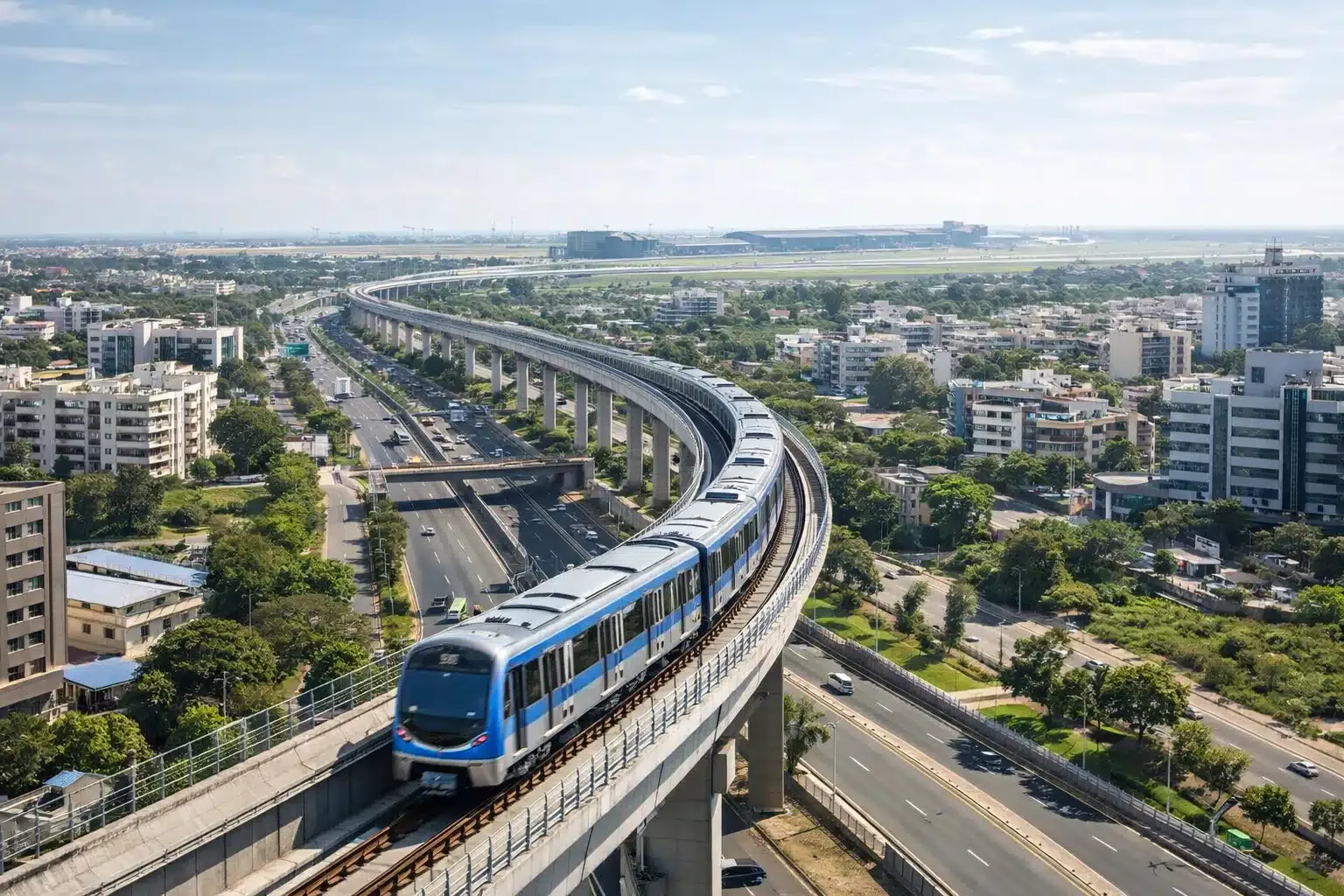
Airport metro impact on Hennur Bagalur Road prices - metro corridor appreciation, property value near metro, and infrastructure-led price growth analysis.
Why Metro Infrastructure Triggers Predictable Price Patterns
Metro infrastructure delivery follows predictable price patterns across Indian metros that have built out their rapid transit networks. The pattern operates in three phases - announcement phase (5-8 percent price premium on adjacent residential as transit case becomes credible), construction phase (3-5 percent additional premium as activation timeline firms), and operational phase (8-15 percent additional premium as commute and lifestyle benefits land). The airport metro impact on Hennur Bagalur Road prices will follow this pattern, with the Airport Metro extension toward the airport corridor progressively activating across the next 3-6 years. Understanding this pattern helps Purva Hennur 51 buyers calibrate forward expectations against the underlying mechanism.
Metro Corridor Appreciation - The Documented Indian Pattern
Metro corridor appreciation has been documented across Bangalore Phase 1 and Phase 2A, Delhi NCR metro rollout, Mumbai metro phases, and Hyderabad metro activation. Residential inventory within 1 km walkability or 2 km drive distance of operational metro stations consistently captures cumulative appreciation of 15-25 percent over the 5-year window following station operationalisation, beyond the broader market appreciation rate. The airport metro impact on Hennur Bagalur Road prices for Purva Hennur 51 will operate through this corridor appreciation mechanism, with the Hebbal station access supporting the metro-proximity premium that the corridor captures.
Property Value Near Metro - The Specific Mechanism
Property value near metro increases through three specific mechanisms that combine to drive the documented premium. First, expanded buyer catchment - metro-accessible residential addresses become viable for buyers across the broader Bangalore catchment rather than just locality-specific buyers, which deepens demand. Second, reduced household vehicle dependence - metro access reduces parking infrastructure requirements and supports lower transportation cost households, which is valued by both end-users and tenants. Third, lifestyle quality - metro commute is materially more pleasant than peak-hour road commute, which buyers price into residential preferences. The airport metro impact on Hennur Bagalur Road prices therefore operates through all three mechanisms rather than just the obvious commute-time reduction alone.
Infrastructure-Led Price Growth Pattern
Infrastructure-led price growth pattern in Bangalore has been consistent across multiple corridors. Whitefield residential prices captured 40-60 percent cumulative appreciation across the ITPL buildout and ORR completion. Sarjapur-ORR corridor captured 35-50 percent across the IT corridor expansion. Electronic City captured 30-45 percent across NICE Road and infrastructure addition. The airport metro impact on Hennur Bagalur Road prices for the Hennur corridor specifically will join this pattern as the metro activation, ORR junction improvements, and broader airport-corridor infrastructure compound over the next decade. The pattern is observed rather than projected - the question is timing and magnitude rather than direction.
When the Premium Lands - Timing Analysis
When the premium lands timing analysis matters for Purva Hennur 51 buyers entering at pre-launch. Announcement-phase premium has already been partially captured into current Hennur Bagalur Road pricing. Construction-phase premium activates as the metro alignment construction progresses across the next 2-4 years. Operational-phase premium activates when stations become operational - market-speculated at approximately 2027-2029 for the relevant Airport Metro segments. For buyers entering at current pre-launch pricing and taking possession in 2029-2030, the construction-phase and operational-phase premiums will substantially activate during the holding window, supporting the appreciation thesis. The airport metro impact on Hennur Bagalur Road prices timing therefore aligns with the typical pre-launch holding cycle rather than missing the buyer's window.
Risks and Calibration
Risks and calibration on the airport metro impact on Hennur Bagalur Road prices thesis include several worth acknowledging. Metro construction timeline risk applies - Indian metro projects historically face 1-3 year activation delays beyond initial timelines. Station location specifics matter - residences within 1-2 km of operational stations capture stronger premium than residences further away. Local infrastructure quality at station access (last-mile connectivity, station design, peripheral road network) affects premium realisation. The airport metro impact on Hennur Bagalur Road prices is therefore a directional thesis with realistic calibration points rather than a guaranteed outcome. Buyers should price these calibration points into expectations rather than relying on optimistic single-point estimates.
Metro Impact Reference
Phase | Approx. Premium Captured | Timing |
|---|---|---|
Announcement Phase | 5-8% one-time | Already partially captured in current pricing |
Construction Phase (Active) | 3-5% additional | Next 2-4 years |
Pre-Operational Phase | 5-8% additional | 12-18 months before station opens |
Operational Phase (Year 1) | 8-15% additional | First year of station operations |
Operational Phase (Years 2-5) | 5-10% additional | Subsequent years |
Total Metro-Linked Premium | approx. 20-35% | Cumulative over 5-7 year activation |
Within Standard Appreciation | Approx. 8-15% of total appreciation | Portion attributable to metro specifically |
FAQ
Will the Airport Metro increase Hennur Bagalur Road prices?
Yes, based on documented metro corridor appreciation patterns across Indian metros. Residential within 1-2 km of operational metro stations typically captures 15-25% cumulative premium over 5-year window following station operationalisation, beyond broader market appreciation.When will the premium land?
Phased across announcement (partial, already captured), construction (next 2-4 years), pre-operational (12-18 months before station opens), and operational (first 1-5 years of station operations). Total metro-linked premium of approximately 20-35% cumulative.What are the risks?
Metro construction timeline risk (1-3 year delays common), station location specifics (within 1-2 km captures stronger premium), and last-mile connectivity quality. Realistic calibration points rather than guaranteed outcome.
Related Articles
Purva Hennur 51 Cost Sheet: Full Price Breakdown for 3 & 4 BHK
Discover the complete cost breakdown for Purva Hennur 51, including BSP, all-inclusive pricing, and configuration details for 3 & 4 BHK luxury apartments in North Bangalore.

Purva Hennur 51 Pre-Launch Review: Is It Worth Buying?
Explore an honest pre-launch review of Purva Hennur 51. Learn about its ratings, builder reputation, location advantages, and whether it’s a good investment in North Bangalore.

Purva Hennur 51 RERA Status: What Buyers Should Know
Learn about the RERA approval status of Purva Hennur 51, potential risks, and why it matters for buyers. Stay informed before investing in this ultra-luxury project in North Bangalore.

Purva Hennur 51 Launch Date & Booking Journey Explained
Discover the expected launch date of Purva Hennur 51 and learn about the step-by-step booking process. Stay informed about pre-launch offers, EOI benefits, and more.